Texas Over-65 Property Tax Exemption: A $200,000 School Exemption and a Tax Freeze. How to Get It
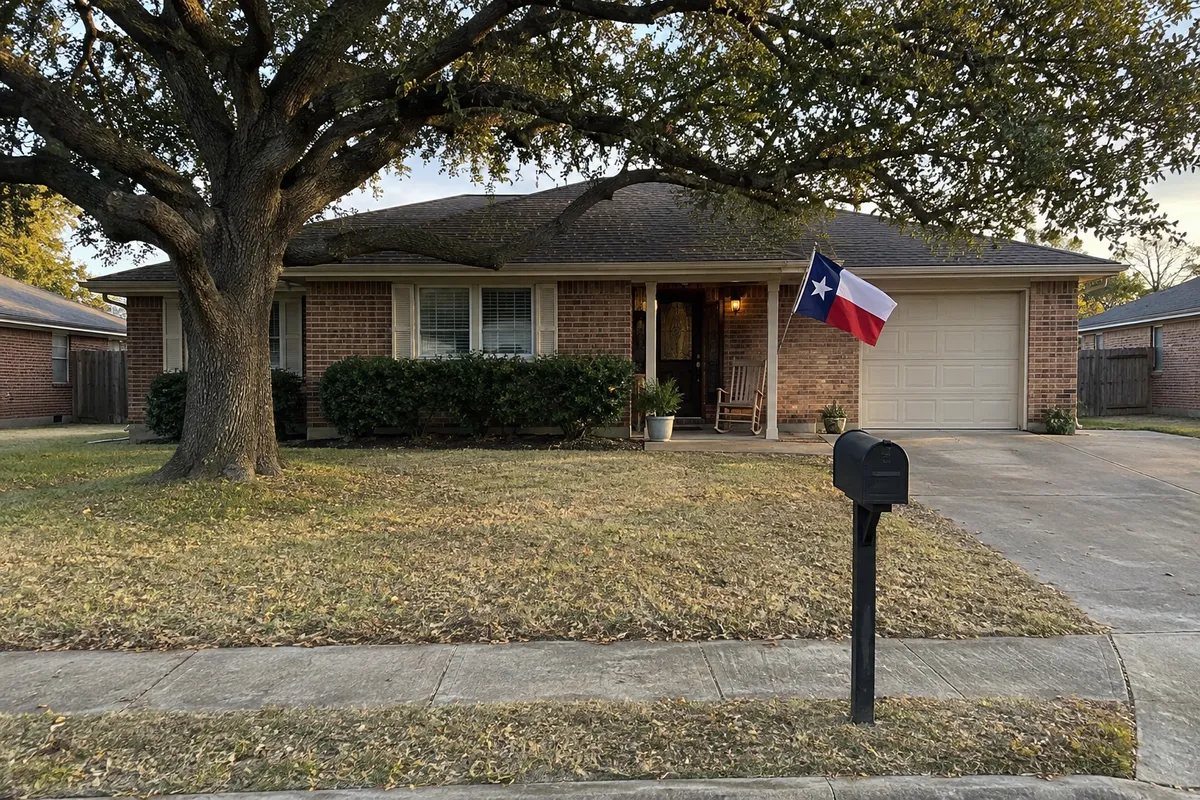
At 64, your Texas school tax bill can climb every year your home’s value does. At 65, it can’t.
If you’re on a fixed income, you know the feeling of opening the appraisal notice each spring and seeing the number go up again. That’s the yearly letter from your appraisal district that shows your home’s value. The over-65 exemption is the first real relief from that.
It does two things, and people mostly talk about one.
The exemption lowers the bill. The freeze keeps it from going back up. The freeze can even follow you to another Texas home, if you ask for it.
What changes the year you turn 65
Your school district, county, and city each tax your home, and each sets its own rules. At 65, several things change at once.
| Benefit | What it does | Who gives it |
|---|---|---|
| Extra school exemption | Takes $60,000 more off your home’s value | Every school district |
| School tax freeze | Stops the school tax from rising | Every school district |
| Local over-65 exemption | Takes at least $3,000 more off your home’s value | School districts, counties, and cities that choose to |
| Installments | Four payments with no penalty | The county tax office, if you ask in writing |
| Deferral | Lets you put off paying, at 5% interest a year | The appraisal district, if you file a form |
Sources: Texas Tax Code sections 11.13, 11.26, 31.031, and 33.06; Texas Comptroller.
If I had one line of the appraisal notice to check first, it would be the freeze. Your notice may call it a “tax ceiling.”
An exemption is a fixed amount. The freeze is worth more every year you stay.
The $200,000 school exemption
Every Texas homestead gets $140,000 off its value before school taxes are figured. At 65, the law adds $60,000.
Every school district has to give that $200,000, and some give more.
Voters approved both amounts in November 2025, and the change covered the 2025 tax bills.

What is that worth in dollars? It depends on your school district’s rate, which is set per $100 of value.
At a rate of $1.00 per $100, the full $200,000 saves about $2,000 a year. The extra $60,000 for age is about $600 of that. In San Antonio Independent School District, the 2026 rate is $1.1552 per $100, so the age part is about $693 a year.
Taken off the value of a Texas homestead for school taxes once an owner is 65 or older. For a married couple, only one of you has to be 65.
The freeze
Once you qualify, your school district can’t charge more in school taxes on that home than it did the first year you qualified.
Say your school tax is $2,400 a year when you turn 65. Ten years later, rising values would have pushed that bill up by half, to $3,600 a year.
A younger neighbor pays the higher bill. You still owe $2,400.
The bill can still go down. It can go up for one reason: you improve the home, such as adding a room. Repairs don’t count.
Ask a Texan over 65 what the exemption saved them and you’ll get a number. Ask about the freeze and you’ll get a bigger one every year.
Counties, cities, and junior college districts can adopt their own freeze. It’s their choice, so ask your appraisal district which ones apply to your address.
Local over-65 exemptions
A school district, county, or city can also give an over-65 exemption of its own. When one does, the law sets the floor at $3,000 off your home’s value. Some give far more.
Northside Independent School District in San Antonio adds $13,330 of its own to the state’s $60,000. The total off for age there is $73,330 in 2026.

These are only examples. Your appraisal district’s website lists what applies at your address.
How to apply
You apply to your county appraisal district. That’s the local office that sets your home’s value and keeps your exemptions. It isn’t the tax office that mails the bill, and it isn’t the state.
Find yours in the Texas Comptroller’s appraisal district directory. It lists each district’s address, phone number, and website. You can mail the form or hand it in, and some districts take it online.
- Fill in Form 50-114, the Residence Homestead Exemption Application.
- Check the box for a person age 65 or older.
- Attach a copy of your Texas driver’s license or state ID. The address on it has to match the home.
- Change the address first, if it doesn’t match. That’s done with the Texas Department of Public Safety, at dps.texas.gov.
You may not have to apply at all. If you already have a homestead exemption and the district has your birth date, the law says it must add the over-65 exemption when you turn 65.
Don’t count on that. The district only knows your birth date if it’s in your file.
Look at the appraisal notice, the yearly spring letter from the district that shows your home’s value and exemptions.
If it doesn’t list an over-65 exemption, send the form. The same form covers you if no homestead exemption is on file at all. It applies for both at once.
Deadlines that work in your favor
The exemption covers the whole year you turn 65, starting January 1.
The date to act on is one year from your 65th birthday. That’s the regular deadline.
Miss it, and the law still takes a late application. You have about two years after that year’s bill comes due.
Say you turned 65 in June 2025. The 2025 tax bill came due around February 1, 2026. Your late cutoff is about February 1, 2028.
The tax office then refunds what you overpaid, and you don’t have to ask for it.
You also don’t reapply each year. Once it’s on your file, it stays while you own and live in the home.
If you lose your husband or wife
If your spouse was the one who was 65, the freeze doesn’t end with them. You keep it if you were 55 or older when they died, and you lose it if you were younger. The home also has to have been your homestead then, and stay that way.
A local over-65 exemption carries on under the same conditions. The extra $60,000 school exemption isn’t on the list of things the law passes to a surviving spouse, so ask the district whether it stays. Either way, your school bill can’t rise above the frozen amount.
Call the appraisal district, say your spouse has died, and ask what it needs to put the freeze and the exemption in your name.
If the bill is still too high
You have two options if you’re 65 or older and the bill is still more than you can pay.
- Installments. You can pay in four equal parts with no penalty or interest. The first is due before the bill becomes overdue, usually February 1. The others are due before April 1, June 1, and August 1. To start, send a written note with that first payment, saying you’re paying in installments. It goes to the tax assessor-collector, the office that mails the bill, at the address on the bill.
- Deferral. You can put off paying property taxes on your homestead by filing Form 50-126 with the appraisal district. Interest runs at 5% a year. The school district, county, and city keep a lien on the home, which is a legal claim that gets paid when the home is sold or passed on.
Moving? Take the freeze with you
Nobody sends you this paper. You have to ask for it.
When you buy another home in Texas, call the appraisal district for your old home and ask for a tax ceiling transfer certificate. “Tax ceiling” is the official name for the freeze. Give it to the appraisal district for the new home.
The freeze moves as a percentage. Say the freeze held your old school tax at $2,400 a year when it would otherwise have been $6,000.
That’s 40%. If the school tax on the new home would be $5,000 a year, you pay 40% of it, which is $2,000.
The new district needs the certificate to figure that percentage. I’d ask for it before the purchase of the new home is final, so the first tax bill there is right.
For other states, see property tax exemptions for seniors.
Your list for the year you turn 65
- Find your county appraisal district in the Comptroller’s directory. Its website has a property search that shows your record and the exemptions on it.
- Check that record for a homestead exemption and an over-65 exemption.
- Make sure your driver’s license shows your home address.
- File Form 50-114, with a copy of your license, within one year of your 65th birthday, if no over-65 exemption shows up.
- Read the first appraisal notice after you turn 65 for two things: the over-65 exemption and the school tax freeze, which may be printed as “tax ceiling.”
- Ask the appraisal district which county, city, and college freezes and local exemptions apply at your address.
- Ask for a tax ceiling transfer certificate before the purchase is final, if you move to another Texas home.
One form, filed once, and the school district can’t raise your bill again.
Sources: Texas Tax Code, Chapter 11 · Texas Comptroller — Property tax exemptions · Texas Comptroller — Form 50-114 · Texas Comptroller — Appraisal district directory · Texas Comptroller — Tax ceilings · Texas Comptroller — Paying your taxes · Texas Comptroller — Form 50-126 · Texas Tax Code, Chapter 33 · Texas Secretary of State — 2025 amendment results · Bexar County — 2026 tax rates and exemptions · Travis County — Tax year 2026 taxpayer impact statement
This article is part of the Home, Taxes, and Estate Guide.