Medicare 100-Day Rule: How the Days Are Counted, When They Reset, and How to Appeal a Cutoff
The discharge planner, the hospital staffer who arranges where your mother goes next, says it on her way out the door. Medicare gives her 100 days.
You write it on the back of an envelope. One hundred days. It sounds like a promise.
It isn’t one. A hundred days is the most Medicare will pay for, not what it owes you.
And the date you need to watch isn’t day 100. It’s printed on a short notice the facility hands you, and it can come with two days’ warning.
I’ll say “your mother” all the way down this page. Swap in your husband, your dad, or yourself. The rules are the same.
These are the rules for Original Medicare, the government plan with the red, white, and blue card. A Medicare Advantage plan is a private plan that replaces it. If she has one, read this box first.
What the 100 days cost
| Day of the stay | You pay in 2026 | You pay in 2027 |
|---|---|---|
| Days 1 to 20 | $0 | $0 |
| Days 21 to 100 | $217 a day | $222 a day |
| Day 101 and after | All of it | All of it |
Source: Medicare.gov, skilled nursing facility care; CMS 2027 fact sheet, November 17, 2026.
Say your mother needs the whole 100 days. The first 20 are free. She has already paid the hospital deductible, the $1,736 she owes in 2026 before Medicare’s hospital coverage starts.
The other 80 days cost $217 each in 2026. That’s $17,360. In 2027, it’s $17,760.
If her stay runs from December into January, you pay each day at that year’s rate.

That daily charge is where a Medigap policy helps. Medigap is private insurance you buy to cover what Original Medicare leaves you to pay.
Medigap plans are named by letter, A through N. The letter decides how much of the daily charge is covered. You’ll usually find it on her Medigap card or in the policy.

Plan K cuts the charge to $108.50 a day in 2026, and Plan L to $54.25. No Medigap plan adds days past 100.
Massachusetts, Minnesota, and Wisconsin use their own plan names. If you live in one of them, call the number on her Medigap card. Ask whether the policy pays the skilled nursing charge for days 21 to 100.
Three things that have to be true first
If you miss any one of these, Medicare pays nothing, not even for day 1.
She was admitted to a hospital for three days in a row. The day she’s admitted counts. The day she leaves doesn’t.
What counts as “admitted” is the trap. Time in the emergency room doesn’t count. Neither does time “under observation.”
Observation means the hospital is watching her without formally admitting her. It can happen even if she sleeps in a bed upstairs.
So ask her nurse or the hospital’s case manager, out loud: is she an inpatient, or under observation? If she’s under observation for more than 24 hours, the hospital must give you a form called the Medicare Outpatient Observation Notice.
If the answer is “observation,” ask her doctor whether she’ll be admitted as an inpatient. Until she is, the three days aren’t adding up.
She goes to the facility soon after. The rule is generally within 30 days of leaving the hospital.
She needs skilled care every day. That means nursing seven days a week, or therapy at least five days a week. Help with bathing and dressing alone isn’t skilled care.
She doesn’t have to be getting better
You may hear that Mom “has plateaued,” so Medicare is done. That isn’t Medicare’s test.
A court settlement known as Jimmo spelled it out. Skilled care to hold her steady, or to slow a decline, still counts. If you remember one sentence from this page, make it the next one.
Medicare’s test is whether she needs skilled care, not whether she’s getting better.
When does the Medicare 100-day rule reset?
Not on January 1. Not with a new illness. The count belongs to something Medicare calls a benefit period, its name for one stretch of illness.
A benefit period starts the day she’s admitted to a hospital. It ends after 60 days in a row out of the hospital. In those 60 days, she also can’t be getting skilled care in a facility.
After that, a new three-day hospital admission opens a new period, with a new 100 days. It also brings a new hospital deductible, charged once per benefit period. That’s $1,736 in 2026 and $1,776 in 2027.
Read this part twice. I had to. She can live in the nursing home the whole time and still reach those 60 days.
If she’s only getting help with daily life, not skilled care, the 60-day count is running.
It cuts the other way, too. Say she uses all 100 days and still gets skilled care every day, paying for it herself. Then the 60-day count never starts, so she doesn’t earn a new 100 days.
| Time away from hospital and skilled care | New 3-day hospital stay needed? | Covered days left |
|---|---|---|
| Under 30 days | No | Whatever is left of the 100 |
| 30 to 59 days | Yes | Whatever is left of the 100 |
| 60 days or more | Yes | A new 100 |
Source: CMS, “Medicare Coverage of Skilled Nursing Facility Care” (publication 10153).
A trip back to the hospital in the middle of her stay doesn’t erase the days she has used. If she used 20 before, she has 80 left when she returns.
And there’s no lifetime limit. She can earn a new 100 days every time that 60-day break happens.
The notice that ends coverage early
One afternoon someone hands you a short notice and asks you to sign it. It’s called a Notice of Medicare Non-Coverage.
It means the facility has decided she no longer needs skilled care. It lists the date Medicare stops paying, and it has to reach you at least two days before that date.
You don’t have to agree with it.
Medicare uses an independent reviewer, called a QIO, for exactly this. Its toll-free number is printed on the notice.
Can’t find it? Call 1-800-MEDICARE (1-800-633-4227) and ask for it.
Then call the reviewer and say you want a fast appeal of a skilled nursing cutoff. Your deadline is noon on the day before the end date on the notice.
Don’t wait for the last morning. Call the day the notice arrives.
The day before coverage ends. That’s the deadline to ask for a fast appeal of a skilled nursing cutoff.
What happens to the bill while you wait? The facility can’t bill her for the disputed days until the review is finished. If the reviewer agrees with the facility, she may have to pay for any days she stayed after the end date.
You’ll get the decision fast. Once the reviewer has her records, it must decide by the end of the next day. I can’t tell you how any one case will come out, because that depends on her chart.
If you miss the noon deadline, call anyway. She may still be able to appeal. But she loses the protection against being billed while the review is going on.
There’s a quieter way for coverage to end. When the 100 days run out, the facility does not have to tell you. Nobody may mention that it’s day 97.
After Medicare stops
Then she pays the facility’s full daily rate. Ask the business office for that number this week, in writing.
Our nursing home cost calculator shows what a stay adds up to. If it turns into a long one, read whether Medicaid will pay.
The calendar on the wall
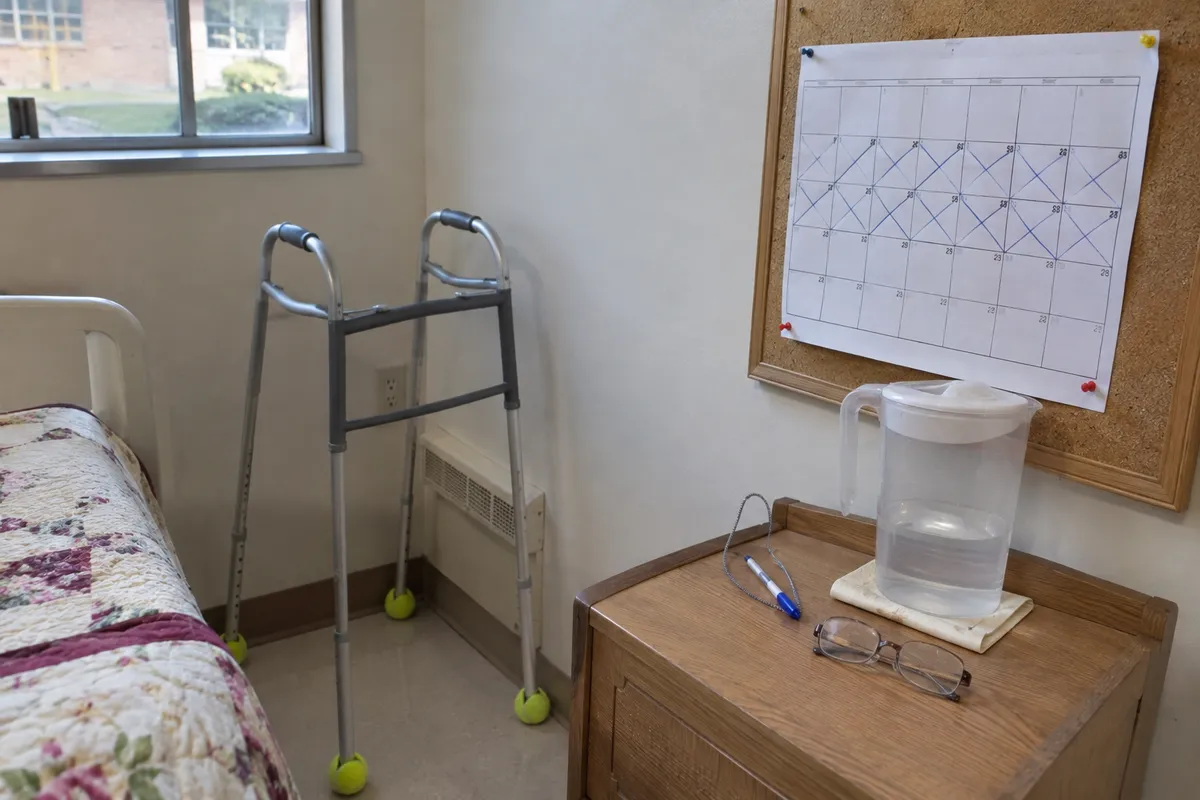
Buy a paper calendar and hang it where she can see it. The facility keeps its own records. This count is yours.
- While she’s still in the hospital, ask her nurse: is she an inpatient, or under observation?
- Find the plan letter on her Medigap card, if she has one.
- Ask the facility’s business office for the first day Medicare covered. Write “Day 1” on that square.
- Mark day 20, the last free day, and day 100. Cross off each covered day as it passes.
- Ask the business office, in writing, for the full daily rate after Medicare stops.
- Tape any notice to the calendar the day it arrives, and call the reviewer that same day.
It’s a small thing, a calendar. But when someone tells you coverage is ending tomorrow, you’ll be the one in the room who knows what day it is.
Sources: Medicare.gov — Skilled nursing facility care · CMS — 2027 Medicare Parts A and B premiums and deductibles · CMS — Medicare Coverage of Skilled Nursing Facility Care (10153) · CMS — Medicare General Information Manual, Chapter 3 · CMS — Jimmo settlement · Medicare.gov — Fast appeals · CMS — Medicare Appeals (11525) · CMS — Notice of Medicare Non-Coverage · 42 CFR 405.1202 · Medicare.gov — Inpatient or outpatient hospital status · Medicare.gov — Compare Medigap plan benefits
This article is part of the Medicare and Nursing Home Guide.