Forgot to Take Your RMD? The 25% IRS Penalty Can Drop to $0. Here's How
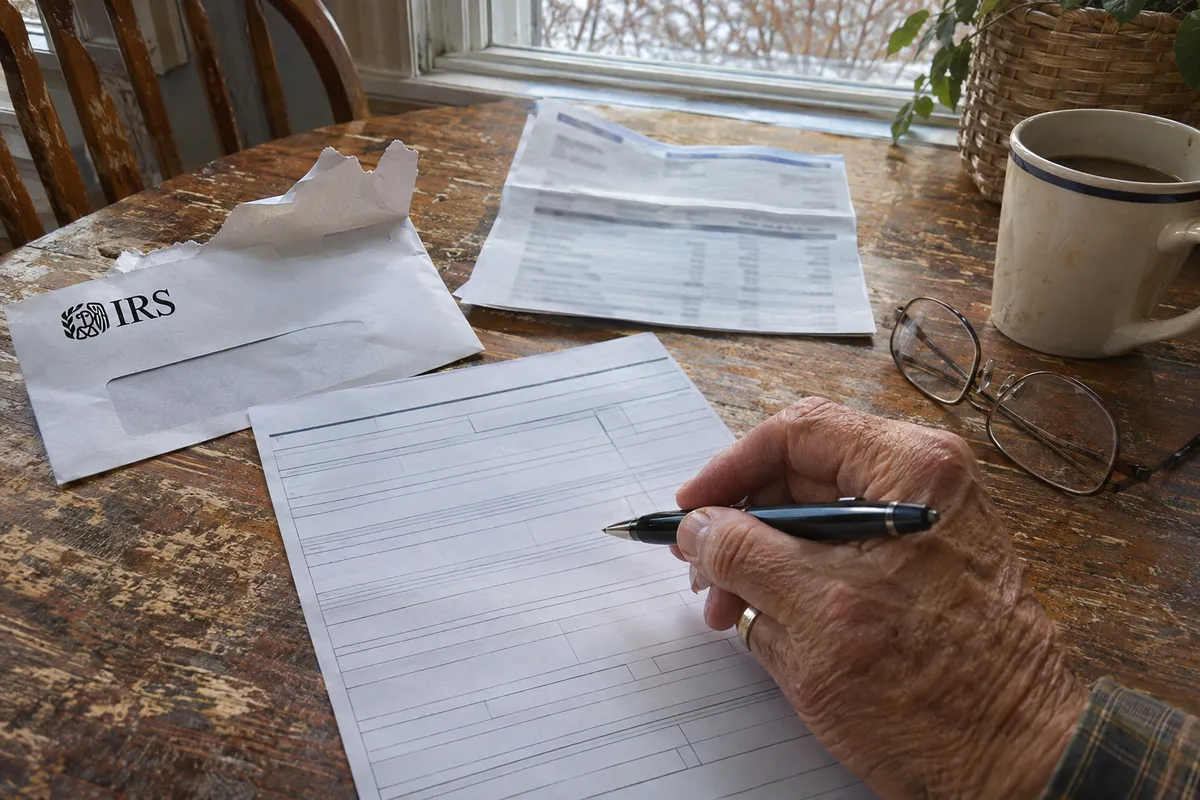
The year-end statement from your IRA shows it plainly: $0 withdrawn. December 31 came and went, and you never took your required minimum distribution. It feels like getting in trouble with the IRS, but this is a fixable kind of mistake.
On a $300,000 IRA at age 73, that was about $11,321 you had to withdraw. The IRS tax for missing it is 25%, or about $2,830.
How much of that you actually pay depends on what you do in the next few weeks.
What happens if you forgot to take your RMD
Once you reach your RMD age, the IRS requires a withdrawal from traditional IRAs and most workplace plans each year. Skip it, and you owe a special penalty tax on the amount you missed.
The tax is 25% of the shortfall. That’s the amount you were required to take, minus what you actually took. If you took half, the tax only applies to the other half.
You still owe regular income tax on the RMD when you take it. The 25% is on top of that.
How much your RMD was
Your RMD is your account balance on December 31 of the year before, divided by a number called the divisor. It comes from the IRS Uniform Lifetime Table, in Appendix B of Publication 590-B on irs.gov. The divisor gets smaller as you age, so the share you must take grows.

Your RMD age depends on your birth year. It’s 73 if you were born from 1951 through 1958, and 75 if you were born in 1960 or later.
Born in 1959? The law reads both ways, so assume 73, which is what the IRS’s proposed rules say.
| When it’s due | Deadline |
|---|---|
| Your first RMD | April 1 of the year after you reach your RMD age |
| Every RMD after that | December 31 of each year |
| Still working, 401(k) at your current job | April 1 after the year you retire, if the plan allows it |
Sources: IRS RMD FAQs; IRS Publication 590-B. The still-working rule doesn’t apply to IRAs or to 5% owners of the business.
Waiting until April 1 for the first one has a catch. You’ll take two RMDs in the same year, and both count as income that year.
When you don’t owe an RMD
Check this first. You may not have owed an RMD at all.
- Roth IRAs never have RMDs while the owner is alive. Roth 401(k)s haven’t had them since 2024.
- Still working: your current employer’s 401(k) can wait until you retire, if the plan allows it. IRAs can’t.
- Inherited IRAs: this applies if you inherited an IRA from someone who died between 2020 and 2023 and was already taking RMDs. There’s no penalty for the yearly RMDs you missed from 2021 through 2024. Starting in 2025, you must take one every year and empty the account within 10 years.
- The year an owner dies: if they hadn’t taken that year’s RMD, the heir can still take it. There’s no tax for the miss if it’s out by the heir’s tax filing deadline, including extensions.
Step one: take the missed money now
Don’t wait for the IRS to find it. Call your IRA custodian, the bank or brokerage that holds your IRA, at the number on your statement. Ask to withdraw the missed RMD as soon as you can.
The law lets the IRS waive the tax when the miss was a reasonable error and you’re taking reasonable steps to fix it. Taking the money out is that step. It’s also how you get the lower 10% rate, but only if you take the full missed amount from the same account that came up short.
What if you missed more than one year? Take each missed amount. You’ll need a separate Form 5329 for each year, using that year’s version of the form.
Your custodian may already have figured the RMD for you. If it tells you the amount, you can use that number.
The 25% can become 10%
If you take the missed RMD and file a return reporting the tax within the correction window, the rate drops to 10%.
For an RMD due December 31, 2025, you have until December 31, 2027. The window closes sooner only if the IRS gets there first, with a formal letter saying you owe this tax or a bill for it. If neither has come, your window is still open.
A first RMD works differently. If you turned 73 in 2025, your first RMD was due April 1, 2026. The IRS treats a miss of that one as a 2026 miss, so you use the 2026 Form 5329, and your 10% window runs to December 31, 2028.

A $2,830 mistake can end at $0, if you ask.
How long the IRS has to come back
For an IRA, the IRS generally has three years to send you a bill for this tax, counted from when you filed your Form 1040 for that year. That clock runs even if you never filed Form 5329.
If you had to file a 1040 that year and didn’t, there’s no time limit at all.
For a missed 401(k) or other workplace-plan RMD, the clock starts only when you file Form 5329.
That doesn’t make waiting a good plan. Fixing the miss early is what gets you the 10% rate or the waiver.
An RMD also counts as income, which can make more of your Social Security taxable. See whether Social Security is taxable after 70.
Taking a late RMD and this year’s in the same year can also push you over IRMAA, the income line where Medicare starts charging higher premiums. It works on a two-year delay. For 2027 premiums, it’s $112,000 of 2025 income for a single person, and it adds at least $83.70 a month to Part B.
Asking for the full waiver
The waiver request goes on Form 5329, in the part for missed RMDs. The IRS publishes no approval rate, but the rule is written for exactly this kind of honest miss. I’d always ask for the full amount rather than settle for 10%.
On the 2025 form, lines 52 to 54 come in two versions.
The “a” lines are for an account you’ve since fixed in full, which qualifies for 10%. The “b” lines are for the rest, at 25%. If you’ve already taken the missed money and want the full waiver, use the “a” lines.
This part of the form is confusing, and it’s fine to take it slowly. What matters most is the RC amount and the short statement.
- On line 52a or 52b, enter the RMD you were required to take. On 53a or 53b, enter what you took by the deadline. Don’t count money you took late.
- Next to line 54a or 54b, write “RC” (short for reasonable cause) and the amount you want waived, in parentheses.
- Subtract that amount from your shortfall, and enter what’s left on the same line.
- Attach a short statement. Explain what happened and that you’ve taken the missed money.
If you ask to waive the whole shortfall, line 55 comes out to $0. You don’t pay the tax when you file.
What you pay up front when you ask for a full waiver on Form 5329. The IRS will bill you only if it says no.
Keep the statement simple and true. Say what got in the way, such as a hospital stay or a mix-up at the bank, and the date you fixed it.
Where the form goes depends on your return:
- Haven’t filed that year’s return yet? Attach Form 5329 to your Form 1040.
- Already filed, and nothing else changes? The instructions don’t address this case directly. Many people mail that year’s Form 5329 by itself, signed, with the statement, to the “Where to File” address; check with the IRS or a tax preparer first.
- Already filed, and other things change too? Send it with Form 1040-X, the amended return.
A 5329 sent by itself can’t be e-filed.
Your fix, step by step
- Check whether you actually owed an RMD: Roth, still working, or inherited IRA rules.
- Ask your IRA custodian for the balance on December 31 of the year before the missed year, or the RMD it figured.
- Find your divisor in Appendix B of Publication 590-B on irs.gov, and divide.
- Take the full missed amount from the same account.
- Write a short statement explaining the miss and the date you fixed it.
- File Form 5329 for each missed year, with “RC” next to line 54a or 54b, before December 31 of the second year after the miss.
- Not filed yet: attach Form 5329 to your 1040. Already filed: ask the IRS or a tax preparer whether to mail it alone or with Form 1040-X.
The worst move
The worst move is to do nothing and hope no one notices. The waiver exists for honest mistakes, but you have to ask for it, and the asking is one line on one form.
Sources: 26 U.S.C. 4974 · IRS — Instructions for Form 5329 · IRS — RMD FAQs · IRS — Publication 590-B · 26 U.S.C. 6501 · IRS — Notice 2024-35 · IRS — Notice 2025-67 · IRS — Notice 2026-66 · 26 CFR 54.4974-1 · CMS — 2027 Medicare Part B premiums · CRS — SECURE 2.0 RMD changes
This article is part of the Home, Taxes, and Estate Guide.